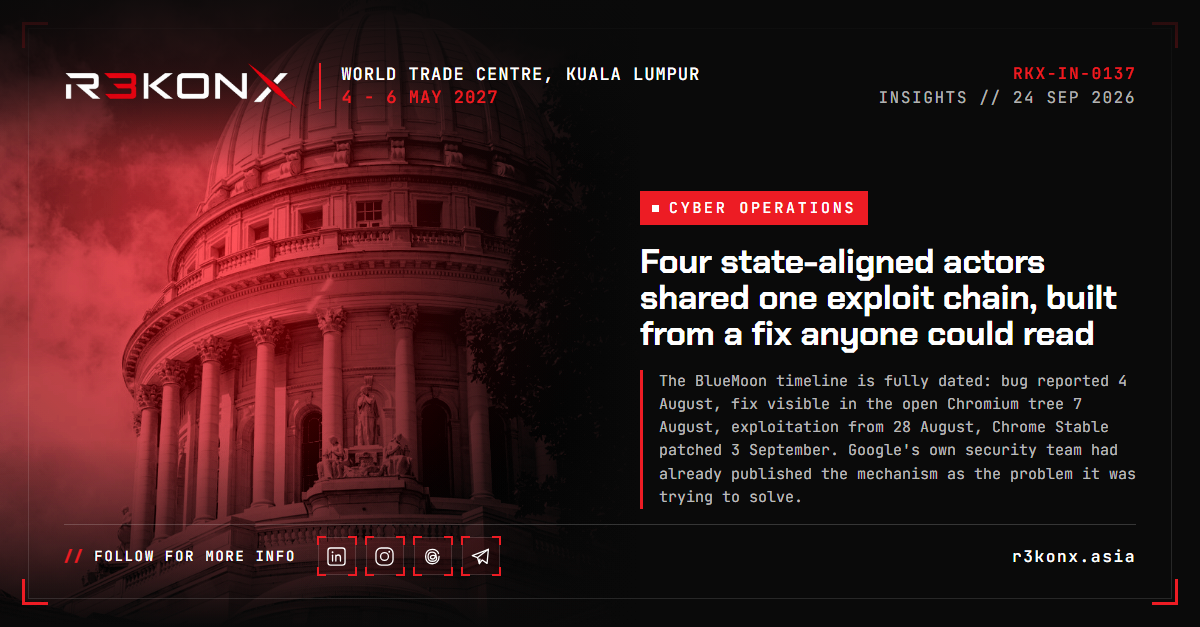
Four state-aligned actors shared one exploit chain, built from a fix anyone could read
The BlueMoon timeline is fully dated: bug reported 4 August, fix visible in the open Chromium tree 7 August, exploitation from 28 August, Chrome Stable patched 3 September. Google's own security team had already published the mechanism as the problem it was trying to solve.
The finding
Proofpoint published research on 9 September 2026 describing an exploit chain it calls BlueMoon, and the part that matters for operations is not the exploits but the calendar [1]. The chain combines CVE-2026-85046, a type confusion in Chrome's V8 engine; CVE-2026-87491, a second V8 flaw used to escape the renderer sandbox; and CVE-2026-85880, an elevation of privilege in Windows Advanced Local Procedure Call [1][8].
Google's own release bulletin dates the first one precisely. CVE-2026-85046 was reported on 4 August 2026 by Salvatore Gulizia, carried a $1,000 reward, and was fixed in Chrome 152.0.7977.82 on the Stable channel on 3 September 2026, in an update that closed twelve security bugs [2]. The bulletin states that Google is aware an exploit for CVE-2026-85046 exists in the wild [2]. The Hacker News records it as the sixth actively exploited Chrome zero-day patched in 2026, added to the US exploited-vulnerability catalogue the same day [3].
Between the report and the patch, the fix was public. Cybernews dates the commit to the open Chromium repository at 7 August, with the Stable release arriving on 3 September – close to a month in which the correction was readable by anyone who watches the tree [5]. Proofpoint dates first exploitation to 28 August [1]. The exploitation began inside the window, after the fix existed and before it shipped.
This is a known mechanism, documented by the vendor
The vendor had already described the problem in its own words. On 30 July 2026, six weeks before BlueMoon surfaced, Google's Chrome Security Team published that once a fix becomes visible in the public codebase, "attackers can start to reverse engineer and exploit the bug before the fix reaches users' machines", that fixes typically take weeks to reach the Stable channel, and that minimising the patch gap is a critical part of its strategy [4]. The same post announced a move towards two security releases per week, beyond the existing two-week milestone cadence, citing fast-moving AI-assisted attacks, and reported 1,072 security bugs fixed across Chrome 149 and 150 – more than the previous twenty-three milestones combined [4].
So the sequence is not a surprise, and BlueMoon is not evidence of a novel capability. It is evidence that the window the vendor identified is being worked, by more than one operator, at the tempo the vendor described. Cybernews notes Chrome's cycle has shortened to two weeks from four, and that this does not remove the n-day gap [5].
Four actors, one kit, days apart
Proofpoint records adoption across four clusters in under a week [1]:
- TA412 – also tracked as JungleBamboo, Violet Typhoon and APT31 – from 28 August, against US non-governmental organisations, mining companies and commodity traders, delivering a browser extension masquerading as an AI tool for credential theft and browser surveillance [1][7].
- UNK_LateNight, from 2 September, against US aerospace companies, delivering ShadowPad with network unhooking and browser profile theft [1].
- UNK_DoubleCheck, from 2 September, against Vietnamese manufacturing, using a Rust loader delivered through DLL side-loading [1].
- UNK_QuietRacket, from 3 September, against Indonesian and Singapore government, consulting and financial sector targets, using custom .NET malware with DNS-over-HTTPS command and control [1][8].
Proofpoint assesses that the majority of the activity is China-linked but states there is insufficient evidence to attribute the chain exclusively [1]. That is the researcher's assessment and its qualification should travel with it. Delivery was spearphishing to actor-controlled domains, with victims shown a loading page while the browser exploit ran before redirection to a legitimate site; infrastructure was registered the same day as, or immediately before, each campaign [1][5].
The operational reading is the sharing, not the sophistication. Proofpoint judges the default configuration's tradecraft poor – fetching an executable to a temporary directory with a command-line utility – and consistent with speed over stealth [1]. BleepingComputer records Proofpoint's observation that the privilege escalation component's compilation timestamp is from 2025 and did not appear forged, suggesting an existing capability repackaged rather than built fresh [7]. A modular chain lets different groups pursue different objectives without rebuilding the attack path, as Nick Tausek of Swimlane put it [6]. Proofpoint expects wider proliferation, including to financially motivated actors [8].
Where the sources disagree
Three disagreements are worth publishing rather than smoothing over.
- Actor naming. BleepingComputer's list includes UTA0560 and does not name UNK_QuietRacket; SecurityWeek and Proofpoint name UNK_QuietRacket as the fourth cluster [1][7][8]. The overlap between vendor designations is not resolved in public.
- The second V8 flaw's patch date. SecurityWeek's BlueMoon coverage gives 8 September for CVE-2026-87491 [8]; its own Chrome 153 report gives 9 September, in 153.0.8010.36, credited to Jihyeon Jeong of Compsec Lab, Seoul National University, with a $2,500 reward and Google confirming an in-the-wild exploit [9].
- Its severity and function. Proofpoint describes CVE-2026-87491 as a sandbox escape overwriting WebAssembly function bodies [1]; BleepingComputer as corruption of WebAssembly metadata [7]; SecurityWeek's release coverage as a medium-severity out-of-bounds write [9]. The first two describe what it was used for, the third what Google rated it.
A fourth is a caution about instrument error generally. For the same Patch Tuesday that carried CVE-2026-85880, Tenable counts 964 CVEs with 104 critical [10], Johannes Ullrich at SANS Internet Storm Center counts 973 with 113 critical [11], and SecurityWeek reports 974 [8]. The characterisation differs too: Tenable describes CVE-2026-85880 as an authentication bypass reaching SYSTEM [10]; Ullrich describes it as a heap-based buffer overflow in ALPC enabling sandbox escape [11]. Both put it at CVSS 7.8 and both record active exploitation [10][11].
What it means
Browser patching is usually treated as a background process that takes care of itself, and privilege escalation flaws rated 7.8 are usually triaged below the nines. BlueMoon inverts both. The renderer bug was rated 8.8, the local escalation 7.8, and chained they produced full compromise of a workstation from a single visited page, on machines whose owners would have described them as current [5][10].
It also changes what a vendor's public commit means. A security fix in an open repository is a specification for the bug it fixes. For any downstream product built on an open upstream – browsers, Chromium-based applications, Electron, embedded engines, Android WebView – the exposure period is not the time from disclosure but the time from upstream commit to shipped build, and that period is set by the slowest thing in the chain, which is rarely the browser itself.
What to do
- Measure the interval from upstream Chromium fix to deployed build across the estate, not the interval from vendor advisory. That is the number that describes exposure.
- Treat browser updates as an emergency channel, not a monthly one. Chrome shipped Stable updates on 3, 9 and 22 September 2026, the last carrying 108 security fixes [2][9][12]. A monthly window guarantees weeks of arrears.
- Inventory Chromium engines you do not think of as browsers. Embedded webviews and packaged desktop applications inherit V8 and rarely inherit the update cadence.
- Hunt on the documented artefacts rather than the exploits: the browser-to-shell process chain, the named scheduled tasks masquerading as update jobs, the extension delivered as an AI assistant, and the published network rules [1].
- Read privilege escalation CVEs as chain components. A 7.8 that turns a sandboxed renderer into SYSTEM is not a second-tier finding [10][11].
- For organisations in the region, treat this as current targeting rather than distant reporting. Government, consulting and financial sector entities in Singapore and Indonesia, and manufacturers in Vietnam, are named victim profiles [1][8].
Domain close
Two things about BlueMoon are durable. The first is that open development, which is the reason browser security has improved, also publishes the bug alongside the fix, and the interval between them is an operational exposure that belongs on a dashboard rather than in a vendor's blog post. The second is that a working chain, once assembled, does not stay with one operator. Four clusters, one of them targeting two ASEAN governments, were using the same kit within six days of first use. Whatever the shared source was, it was not a long-planned campaign; it was a component moving faster than the patch.
Sources
Every R3KONX article cites its primary material. 12 sources, in order of first citation. Links open the original publication.
- Once in a BlueMoon: Multiple State-Aligned Threat Actors Rapidly Adopt Novel Exploit Chain Using Chrome and Windows Zero-Days Proofpoint Threat Research · 2026-09-09
- Stable Channel Update for Desktop (Chrome 152.0.7977.82) Google Chrome Releases · 2026-09-03
- Google Releases Chrome Update to Patch Actively Exploited V8 Zero-Day The Hacker News · 2026-09-04
- Stronger with every update: How we're making Chrome and the web safer in the AI Era Google (Chrome Security Team) · 2026-07-30
- Simply visit a website, and you're completely compromised: Chinese hackers exploited Chrome's patch gap Cybernews · 2026-09-22
- Attackers are weaponizing the gap between Chromium fixes and Chrome patches CSO Online · 2026-09-10
- New 'BlueMoon' kit exploited Windows and Chrome zero-day flaws BleepingComputer · 2026-09-10
- BlueMoon Exploit Kit Chains Recent Chrome, Windows Zero-Days SecurityWeek · 2026-09-12
- Chrome 153 Patches Seventh Zero-Day of 2026 SecurityWeek · 2026-09-09
- Microsoft's September 2026 Patch Tuesday Addresses 964 CVEs (CVE-2026-81963, CVE-2026-85880) Tenable · 2026-09-08
- September 2026 Microsoft Patch Tuesday SANS Internet Storm Center (Johannes Ullrich) · 2026-09-08
- Chrome Releases: September 2026 archive (Chrome 154 Stable, 108 security fixes) Google Chrome Releases · 2026-09-22
Researched and written by the R3KONX analysis desk from the cited primary material. Methodological caveats: actor naming, the patch date for CVE-2026-87491 and its severity classification differ between the sources cited, and both figures are published here rather than reconciled; cisa.gov was unreachable from this desk, so the catalogue date for CVE-2026-85046 is carried from The Hacker News rather than attributed to CISA's own page. Attribution statements are the assessments of the named researchers. Corrections to event@r3konx.asia.