

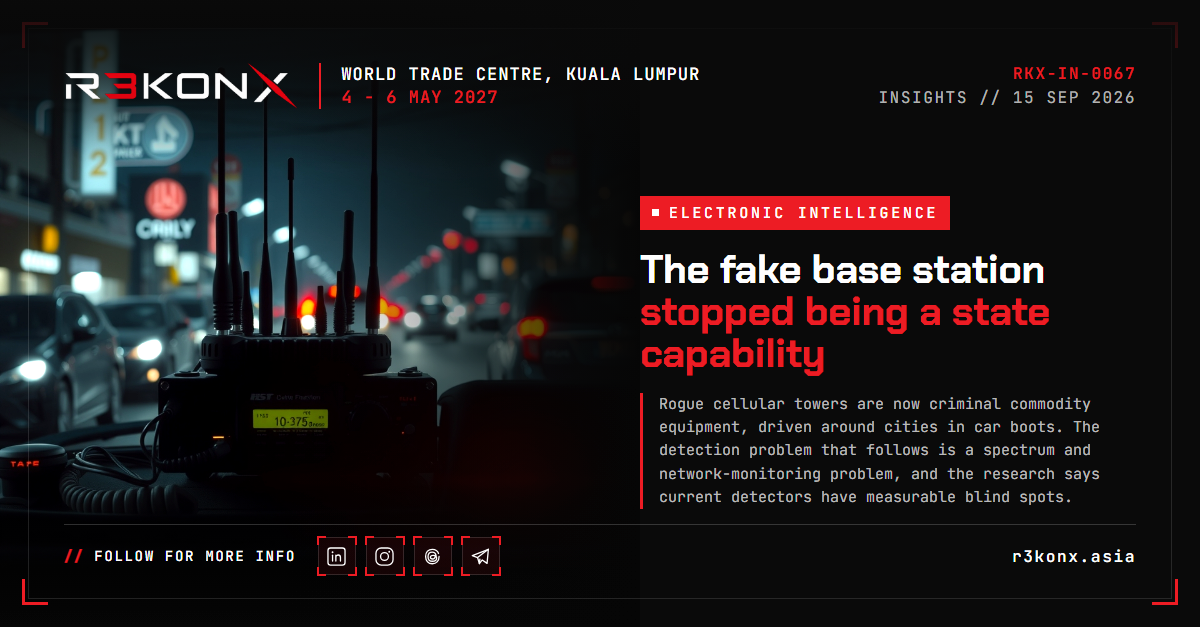
The fake base station stopped being a state capability
Rogue cellular towers are now criminal commodity equipment, driven around cities in car boots. The detection problem that follows is a spectrum and network-monitoring problem, and the research says current detectors have measurable blind spots.
The shift
Cellular impersonation used to imply a state customer. The equipment was expensive, export-controlled in practice, and its operators were law enforcement or intelligence services. That has changed. Across 2026 the same capability has been prosecuted repeatedly as ordinary criminal equipment: a device in a vehicle, driven through dense urban areas, harvesting attachments from every handset in range and pushing fraudulent messages to them [2][8].
The Toronto case is the clearest documented example because the police published operational detail. Project Lighthouse began in November 2025 after a security partner alerted police to a suspected device operating downtown [1]. Investigators established that the device was mobile and run from vehicles, moving around the Greater Toronto Area [1]. Two men were arrested on 31 March 2026 and a third surrendered on 21 April [3]. Police stated that tens of thousands of devices connected to the rogue network over several months [1][4], and reporting of the case records more than 13 million network disruption events, periods during which affected handsets could not connect to legitimate networks [4][5].
Why this is an ELINT problem and not a fraud problem
The fraud is the payload. The capability is the emitter, and emitters are detected by their behaviour in the spectrum and in the network, not by what they say.
The mechanism is well understood and unchanged for a decade: handsets prefer the strongest available signal, and the handset cannot independently verify that the base station belongs to a legitimate operator [6][11]. Second-generation networks require only the handset to authenticate, not the network, and later generations that do mandate mutual authentication can in practice be circumvented by pushing a device into legacy compatibility mode where operators still support it [11]. Every mitigation argument eventually reduces to how much legacy fallback remains switched on in a given market — which in much of Southeast Asia is more than in Western Europe.
That makes detection a monitoring discipline. Legitimate base stations carry registered identifiers visible to carrier monitoring; a rogue one does not, so a cluster of devices reporting attachment to an unregistered station is itself a signal [7]. The Toronto investigation was run in coordination with a national carrier, which is how the device was tracked across locations [6]. Localising the physical emitter, however, still required mobile scanning capability that most police forces have only recently begun to field [7]. That is a direction-finding problem, and it is the part that does not scale from a desk.
What the research says about detection
Practitioners should not assume the detection side is solved. A 2026 adversarial modelling study, Devilray, sets out a systematic model of evasion against fake base station detection and reports blind spots in existing approaches [9]. It builds on work presented at NDSS in 2025 that characterises identity-exposing messages in cellular traffic as a detection signal [9]. A separate survey of the problem across fourth- and fifth-generation networks catalogues both network-side countermeasures — signal analysis, authentication and encryption mechanisms — and device-side ones, and is candid about their limitations [12].
The practical reading: detection research has moved from whether rogue stations can be spotted at all to how reliably they can be spotted by an adversary who knows the detectors exist. Anyone procuring a detection capability should be asking vendors about performance against evasive emitters, not about detection of naive ones.
The regional picture
Reported enforcement extends well beyond North America. A vehicle-based device was reportedly seized in Vienna in May 2026, with Austrian authorities estimating that several million messages had already been sent, and a criminal trial in Paris involving a cellular interception smishing operation has been reported with losses estimated around €20m [8]. A vendor compilation lists seizures in the Philippines, vehicle-mounted equipment recovered in Bangkok, and arrests in Cambodia [10]; those specific counts trace to a commercial summary rather than to primary records and are recorded here as unverified. Reporting on the Toronto case notes similar incidents in Greece, Thailand, Indonesia, Qatar and the United Kingdom [2].
For Malaysia and the wider region the exposure is structural rather than speculative. Dense urban corridors, high mobile penetration, extensive legacy network fallback and a mature scam-messaging economy are exactly the preconditions this equipment exploits. The cases above involve devices moved through transport hubs and crowds — a category that includes conference venues, transit stations and large public events.
What to do about it
- Treat unexplained loss of service as a collection signal. A cluster of handsets losing carrier connectivity in an area with normally strong coverage is an observable, and in the documented cases it was the most visible one [5].
- Work the carrier relationship before you need it. Network-side identifier monitoring sits with the operator, and the documented detections depended on that cooperation [1][6].
- Understand that emergency call availability is part of the impact. Attached devices could not reach legitimate networks, which is a public safety consequence distinct from the fraud [5][7].
- For sensitive sites and events, plan RF survey capability as a temporary deployment rather than a permanent installation, since the threat is mobile by design [1][7].
- Push legacy fallback down where the estate allows it, and know which of your devices will still drop to a network generation without mutual authentication [11][12].
Electronic intelligence close
There is a wider lesson here about capability diffusion. Techniques developed for lawful interception and signals collection do not stay in that lane once the hardware becomes cheap and the software becomes available; they reappear as criminal tooling with the same physics and a cruder objective. The defensive consequence is that the detection burden shifts from national agencies to carriers, regulators, and the security teams of anyone operating a large site — organisations that have historically owned no spectrum-monitoring capability at all and have rarely been asked to.
The Toronto case is being described as a first prosecution rather than a last one [7]. The relevant question for regional operators is not whether this equipment will appear locally, but whether anyone would notice if it already had.
Sources
Every R3KONX article cites its primary material. 12 sources, in order of first citation. Links open the original publication.
- Unprecedented SMS Blaster Arrests Toronto Police Service · 2026-04-23
- Toronto police arrest three in Canada's first mobile SMS blaster case The Record (Recorded Future News) · 2026-04-24
- Toronto police make three arrests as part of 'SMS blaster' cyber fraud investigation Data Center Dynamics · 2026-04-24
- Canada SMS Blaster Cybercrime Case Triggers Major Arrests The Cyber Express · 2026-04-27
- Fake Cell Towers Hijacked Phones Across Toronto to Send Phishing Texts GBlock · 2026-04-26
- Canada's First SMS Blaster Bust: Project Lighthouse ScamWatchHQ · 2026-04-25
- Canada's First SMS Blaster Arrests: Three Men Who Knocked Out 911 Access for Thousands of Phones Breached.Company · 2026-04-24
- SMS Blaster Scam: Fake Cell Tower Smishing (2026) SafeBrowz · 2026-06-23
- Devilray: A Systematic Adversarial Model Revealing Blind Spots in Fake Base Station Detection arXiv · 2026-05-01
- SMS Blast Scams: The New Frontier of Mobile Fraud Rayzone Group · 2026-07-08
- IMSI-Catchers Explained: Mobile Network Interception FAQ, Detection, and Protection HackMag · 2026-06-18
- The Impact of IMSI Catcher Deployments on Cellular Network Security: Challenges and Countermeasures in 4G and 5G Networks arXiv · 2024-05-01
Researched and written by the R3KONX Analysis Desk from the cited primary material, with AI assistance in research and drafting. Methodological caveat: enforcement case details come from police statements and reporting of them, and compiled regional case lists have not been independently verified against primary records; where a figure's origin cannot be traced it is marked unverified. No operational detail on constructing or operating cellular impersonation equipment appears here. Corrections to event@r3konx.asia.