

South Korea builds the electromagnetic warfare organisation seven years before the aircraft
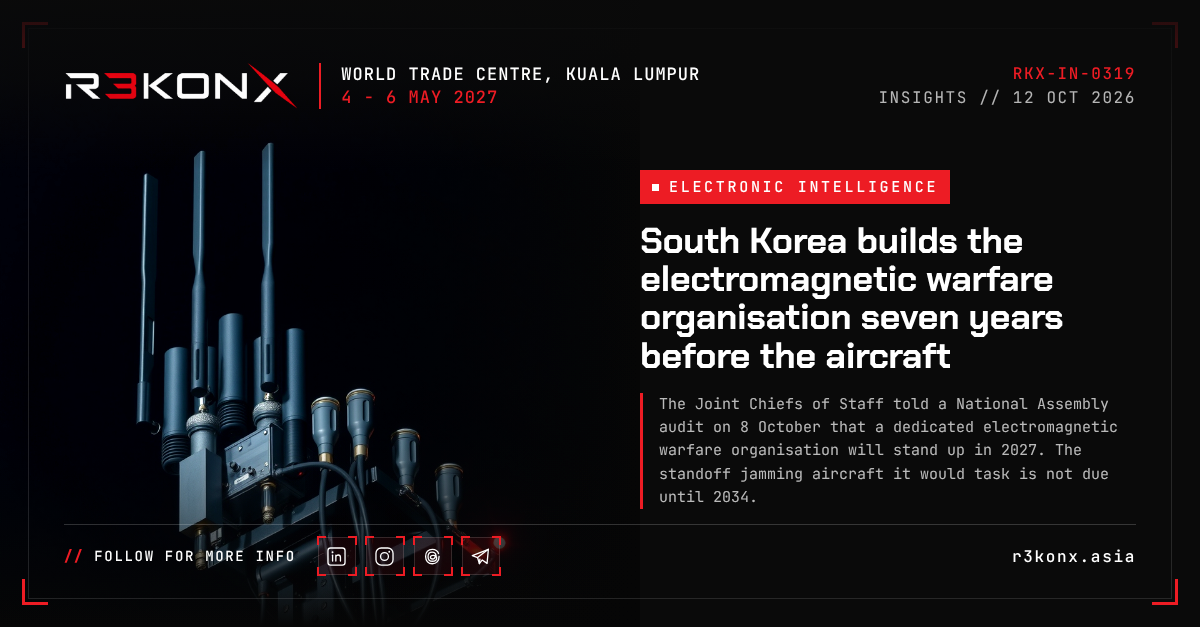
The Joint Chiefs of Staff told a National Assembly audit on 8 October that a dedicated electromagnetic warfare organisation will stand up in 2027. The standoff jamming aircraft it would task is not due until 2034. The ordering is the decision worth reading.
A joint staff organisation before a jamming aircraft
South Korea will create a dedicated electromagnetic warfare organisation inside its Joint Chiefs of Staff next year. The JCS disclosed the plan in its report to a National Assembly Defense Committee audit on 8 October 2026 [1][3]. Chairman Jin Young-seung told the same committee that the military recognises the need for a Space Command and is preparing one, and that space functions had already been reviewed when the Strategic Command was being prepared [2][4]. Of the two moves, the electromagnetic one comes first.
That sequencing is the substance of the announcement. South Korea fields no dedicated electronic attack aircraft. Its Baekdu and Geumgang platforms are passive collection aircraft, and the active electronic warfare role over the peninsula has been filled by United States EC-130H aircraft deployed to Korea [6]. The Defense Acquisition Program Administration launched development of a standoff jamming aircraft, designated Block-I, on 20 January 2026, with deployment targeted for 2034 if development succeeds [5]. An organisation created in 2027 will therefore exist for roughly seven years before the platform it would task is in service.
What the organisation is being asked to do
The remit as reported is architectural rather than operational. The JCS said the organisation will develop electromagnetic spectrum operations into a system that collects and analyses electromagnetic signals from vehicles, unmanned aerial vehicles and satellites, and shares the results [1]. It will develop concepts and doctrine for electromagnetic spectrum operations, covering both electromagnetic attack on an opponent and management of the military’s own spectrum use. It will also work to reduce the effect of enemy jamming on friendly forces [1].
The pairing in that second item carries more weight than it reads. Electromagnetic attack and own-force spectrum management are conventionally held by different staffs with different incentives, and the friction between them is not administrative. Denying an adversary a band can deny the same band to friendly forces, so coordination has to cover frequency allocation alongside force, time and space [10].
The United States formalised the same merger in 2020, folding electronic warfare and spectrum management into a single electromagnetic spectrum operations community, with joint cells at combatant commands and electromagnetic battle management to monitor and direct operations in real time [9]. The ROK remit, as described to the committee, maps onto that model closely enough that the model is the useful reference point for judging it.
Accounts of the remit diverge on one element. Seoul Economic Daily reports that the organisation will help link government and military detection systems for responding to North Korean radio interference [2][3]. The Asia Business Daily account sets out the collection, doctrine and jamming-mitigation remit without that civil-military linkage [1]. The News1 account gives only the general aim of strengthening operations in the space and electromagnetic domains [4]. The two fuller accounts are not contradictory, but the linkage appears in one and not the other, and the Asia Business Daily page carries a machine-translation notice. Until a JCS or ministry document is published, the civil-military element should be treated as reported rather than confirmed.
The measurement problem underneath
The problem the organisation is being built against is documented unevenly. Ministry of Science and ICT data reported in September 2025 recorded North Korean GPS interference crossing the Northern Limit Line every day from 2 October 2024 to 26 August 2025. Nearly 5,000 aircraft and 1,000 ships were disrupted over roughly 300 days, and at least three ROK Navy unmanned camcopters were brought down [6]. For the earlier period, 578 reported false-signal broadcasts against GPS were recorded between January and August 2024, against 39 in the whole of the preceding year and 26 in each of the three years before that [8]. Most of those cases were traced to North Korea, the heaviest concentration fell between 29 May and 2 June 2024, and interference episodes ran from a few minutes to several hours [8].
The 2026 picture reads differently. The Central Radio Management Service, the civil radio regulator under the Ministry of Science, told NK News on 3 July 2026 that it had detected no North Korean GPS jamming near Baengnyeong Island so far that year [7]. That is one sensor location, one agency and one half-year, and it is not a national count. The two readings are not in conflict; they measure different quantities at different points. But they cannot be added, compared or trended, which is the operational problem. South Korea has also not published a defence white paper for two consecutive cycles [12], so the regular public account against which a national series would normally be read is absent.
This is why the civil-military detection linkage, if it is in the remit, is the most consequential part of it. The 2024 episodes were measured by a civil regulator, reported by civil aviation and maritime operators, and responded to by military and coast guard organisations with no shared procedural basis. The recommendation after those episodes was a joint procedural manual, starting between the navy and the coast guard and expanding outwards [8]. An organisation that owns the shared picture is a precondition for that, and it is cheaper than a platform.
Why putting the organisation first is defensible
There is a straightforward case for the ordering. An organisation that holds doctrine, collection and deconfliction can absorb a platform when it arrives and task it inside an existing framework. A platform delivered to a single service with no joint owner for spectrum deconfliction creates the fratricide risk described above, and creates it at the moment of highest operational pressure. On that reading, 2027 is not early for the organisation; 2034 is late for the aircraft.
The unresolved question is where electromagnetic spectrum operations will finally sit. The ROK Strategic Command, launched on 1 October 2024 to oversee major strategic systems, was always intended to expand later into space, cyber and electromagnetic spectrum operations [11]. Jin’s remark that space functions were considered during the Strategic Command’s preparation [2] indicates that the boundary between the Strategic Command, the prospective Space Command and a JCS electromagnetic organisation has not been settled. Three candidate owners for one domain is a recognisable pattern, and it usually resolves slowly.
What practitioners should take from this
Three things are worth carrying forward. First, procurement timelines are a poor proxy for capability timelines in this domain; the organisational decisions are the ones that change how a force behaves, and they are announced in committee reports rather than in contract awards. Second, the civil-military detection linkage is the one commitment in the announcement that can be audited from outside, because either a shared reporting path exists or it does not. Third, the budget figure for the aircraft is published two ways: 1.9 trillion won, given as about US$1.29 billion, in January 2026 [5], and about 1.78 trillion won, also given as about US$1.29 billion, in September 2025 [6]. Both figures are in the public record and they differ. Either the programme value moved between the two reports or one conversion is loose. Neither source resolves it.
The regional read
For the rest of the Asia-Pacific the transferable element is institutional, not Korean. Civil monitoring networks sit with telecommunications regulators. Military spectrum use sits with defence ministries. Aviation and maritime interference reports arrive through operators and air navigation service providers. In most states these three sets of records are not joined, and the ROK case shows where the difficulty actually lies: not in acquiring sensors, which the civil regulator already operates, but in agreeing a single picture and a procedure for acting on it. A state that builds the joint staff function first is buying the ability to use interference data it is already collecting. That is a cheaper first move than any airframe, and it is the one most regional forces have not yet made.
Sources
Every R3KONX article cites its primary material. 12 sources, in order of first citation. Links open the original publication.
- JCS to Establish Electromagnetic Warfare Organization Next Year The Asia Business Daily · 2026-10-08
- South Korea's Military Pushes to Create Space Command Seoul Economic Daily · 2026-10-08
- '우주사령부' 창설 추진…내년 전자기전 전담조직도 신설 [국방위 국감] Seoul Economic Daily · 2026-10-08
- 합참, '우주사령부' 창설 추진…내년 전자기전 전담조직 신설 News1 · 2026-10-08
- Project launched to develop electronic warfare aircraft for deployment in 2034 The Korea Times · 2026-01-20
- As North Korean jamming threat grows, South's Air Force ups its electronic warfare game Korea JoongAng Daily · 2025-09-17
- No reports of North Korean GPS jamming near maritime border, Seoul says NK News · 2026-07-03
- North Korean Non-kinetic Attacks: A Problem for Incheon Airport 38 North, Stimson Center · 2024-11
- Electromagnetic Spectrum Superiority Strategy United States Department of Defense · 2020-10
- The Electromagnetic Spectrum: The Cross Domain Joint Air Power Competence Centre · 2015-11
- South Korea launches Strategic Command to integrate with U.S., counter North Korea, push peace through strength Indo-Pacific Defense Forum · 2024-10
- S. Korea to forgo defense white paper for 2nd straight year The Korea Herald · 2025-12-17
Researched and written by the R3KONX analysis desk from the cited primary material. Two caveats apply. The remit described here comes from press accounts of an oral report to a National Assembly committee, not from a published Joint Chiefs of Staff or Ministry of National Defense document, and one of those accounts carries a machine-translation notice. The interference figures quoted come from different agencies measuring different quantities at different points, and are published here as such rather than reconciled. Corrections to event@r3konx.asia.